Dome roof or floating roof? Telling crude tanks apart in satellite imagery
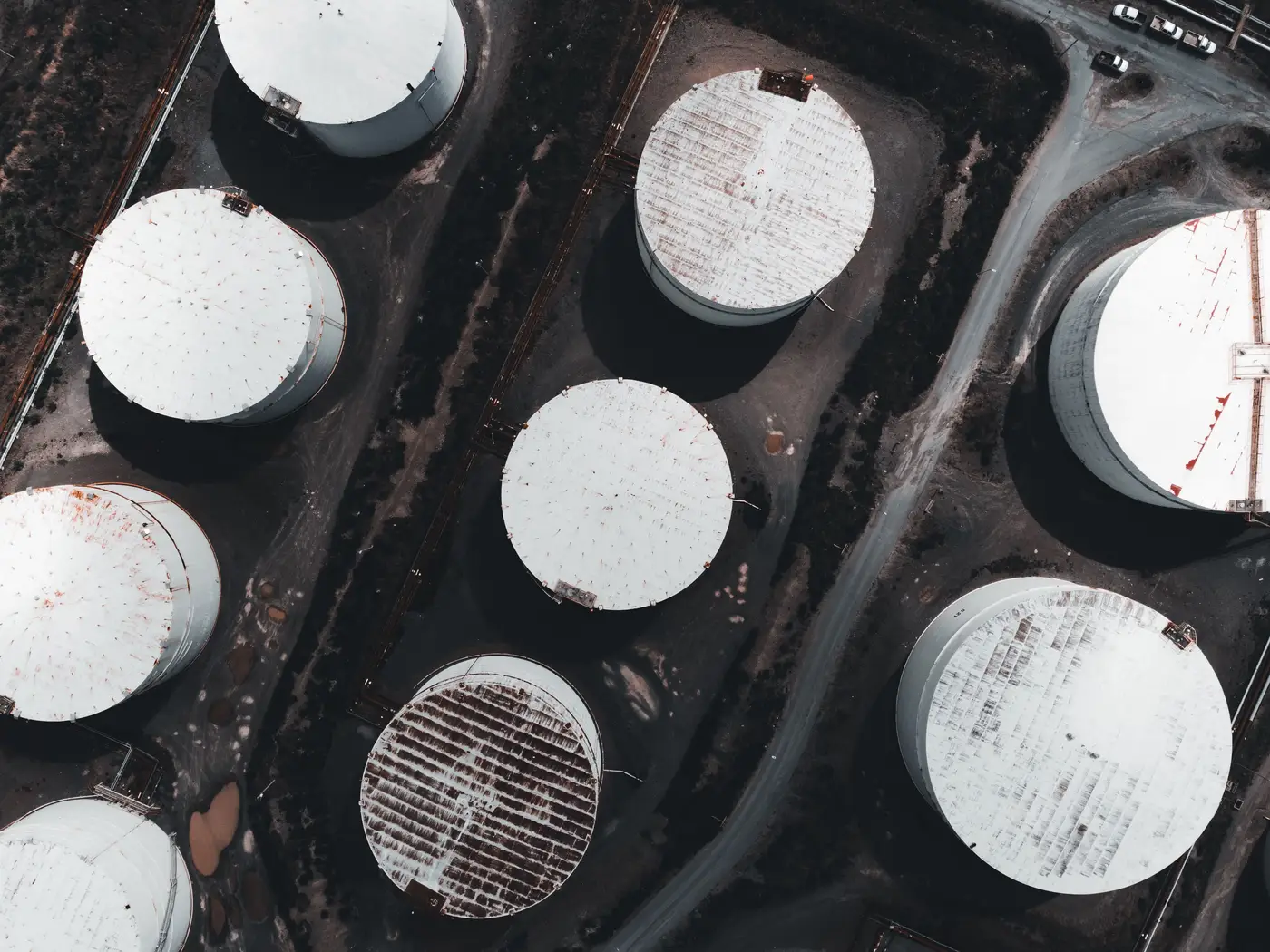
Pull up a tile over any crude terminal and the tank farm looks uniform at first glance. Rows of circles, same gray concrete rings, same shadows at the same sun angle. Zoom in and the roofs split into two camps that behave nothing alike for storage math: the ones with a visible floating deck, and the ones under a fixed dome.
Knowing which is which matters before you trust a single fill number pulled from imagery. A shadow-based read only works on one of them.
What a floating roof actually looks like from above
An external floating roof (EFR) tank has a deck sitting directly on the crude, rising and falling with the level inside the shell. From a satellite pass, that shows up as a thin ring of shadow between the deck edge and the tank wall, usually widest on the side away from the sun. That gap is the seal zone, primary seal and sometimes a secondary one riding just above it, and its width changes week to week as the tank fills or draws down. You can often make out the rolling ladder too, a diagonal line crossing the deck that pivots as the roof height shifts.
The deck itself usually reads as a flat, slightly textured disc, sometimes a shade different from the rim because of standing water or coating. None of that is present on a fixed roof.
Spotting a dome roof tank
A geodesic dome roof tank reads completely differently. Instead of a flat deck with a seal gap, you get a continuous curved or faceted surface, the triangulated panel pattern is often visible at good resolution, rising to a low apex near the center. There's no ring shadow because there's no moving deck edge. The shadow a dome casts depends on the dome's fixed curvature and the sun angle that day. It stays essentially the same from one week's pass to the next, while a floating roof's seal shadow widens and narrows as the deck rides the level.
Some of these are true fixed-roof tanks with no floating roof at all, often holding less volatile product. Others are internal floating roof (IFR) tanks: a floating deck does sit inside, but it's hidden under the dome, which was added later to cut evaporative losses or handle a windier site. From orbit, both look the same. Both are dead ends for a shadow read, because the thing a shadow-based fill estimate depends on, that exposed, moving deck edge, is covered up either way.
Why the split matters for a storage read
Oil Tank Fill works off the shadow geometry of the floating roof itself, the crescent of light and dark that widens and narrows as the deck rides the crude level up and down the shell. That method has nothing to measure on a dome. No visible deck, no seal gap, no shadow that tracks fill.
The first pass over any defined area is roof-type sorting as much as it is tank counting. A dome gets flagged as non-floating-roof storage and set aside rather than forced into a fill number that imagery alone can't support. That's a cleaner answer than a confident-looking estimate built on the wrong geometry.
A few field cues help when a tile is borderline: look for the apex vent, a small raised cap near the dome's center, and check whether the shadow pattern repeats pass after pass regardless of how the tank's been trading. If the shadow doesn't move, you're looking at a fixed roof no matter what the fill level inside actually is.
If you're running a defined area and need to know which tanks in the yard are even candidates for a daily fill read, that's the sorting Oil Tank Fill does before it reports a single number.