IFR vs EFR tank: how to tell them apart from the air
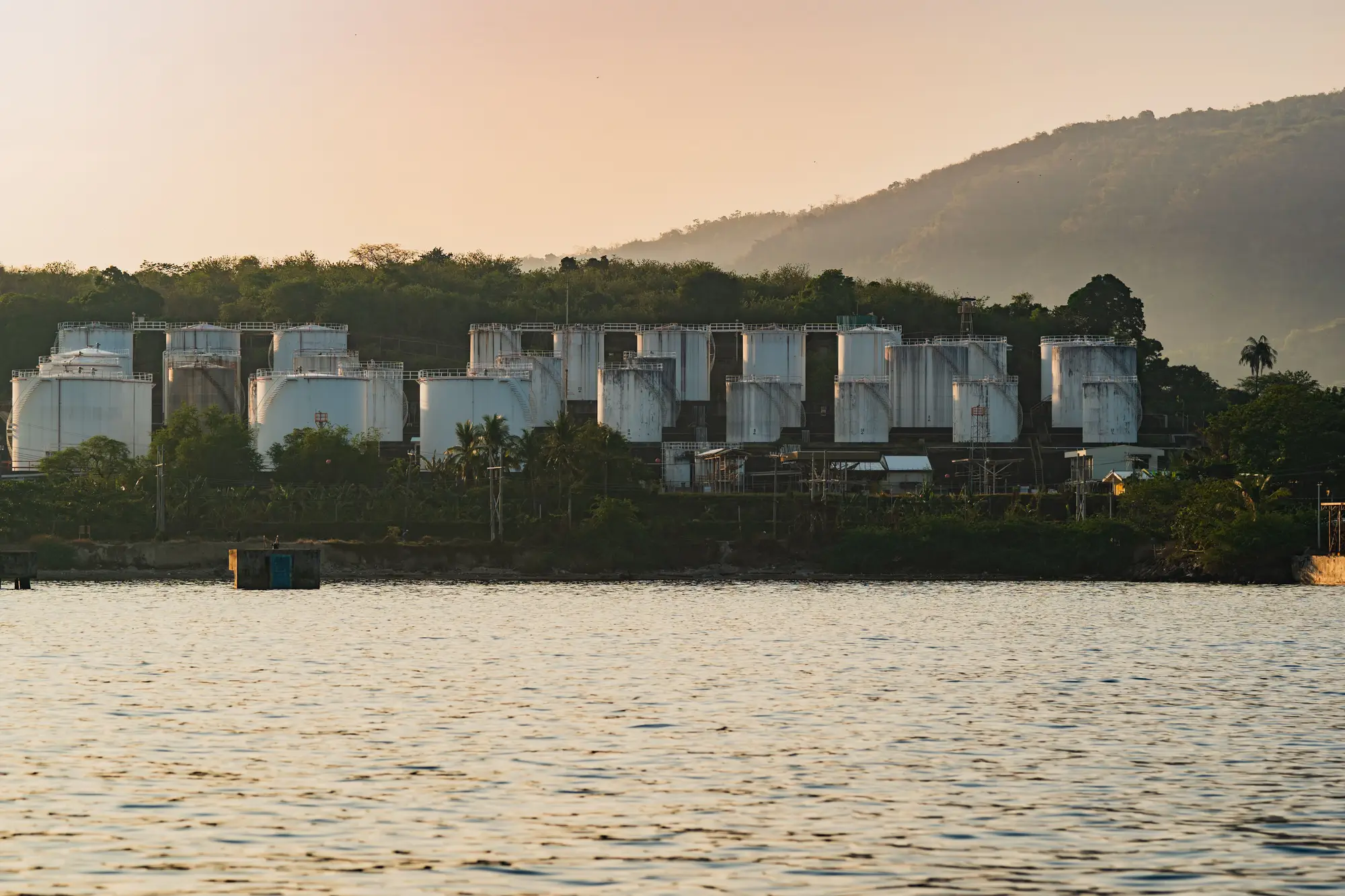
If you're scanning imagery of a tank farm and trying to work out which tanks will give you a fill read, the first thing to sort out isn't resolution or cloud cover. It's roof type. Not every round steel tank in a storage yard is built the same way, and the difference matters a lot more than it looks like from 40,000 feet.
Two roof families show up in most commercial storage: external floating roof (EFR) and internal floating roof (IFR), sometimes called a covered floating roof or domed tank. They solve the same problem, vapor loss and fire risk from a fixed headspace sitting on top of volatile product, but they look completely different from above, and only one of them gives you anything to read optically.
What you're looking at
An EFR tank has no fixed roof at all. The floating roof, usually a steel pan or pontoon ring, sits directly on the product surface and rises and falls with it, fully exposed to the sky. Open the top of the tank and that's all there is: a disk floating inside a steel shell, with a rim seal running around the edge to keep rain and vapor out of the gap.
An IFR tank, by contrast, has a fixed roof, a cone or shallow dome, bolted or welded on top like any conventional tank. The floating pan still exists, but it floats underneath that fixed cover, inside the tank, completely hidden from view. "Covered floating roof" and "domed tank" are just other names traders use for the same construction. The internal floater is doing the same vapor-control job as an EFR's roof, you just can't see it because there's a lid over the whole thing.
From the ground this distinction is obvious. From a satellite pass or a high-altitude frame, it's the whole ballgame, because fill-level estimation from imagery depends on reading the roof's position relative to the tank wall, and you can only do that if the roof is the thing facing the camera.
Field marks that give it away
A few things to check before you spend time on a tank:
- Roof edge. An EFR tank shows a visible gap or rim between the floating roof and the tank wall, often with a walkway grating ringing the top. A domed or IFR tank shows a continuous, unbroken surface, cone-shaped or gently arched, no gap anywhere.
- The rolling ladder. EFR tanks carry a sloped access ladder running from the top rail down to the roof. Its angle changes as the roof rises and falls with inventory, so in sequential imagery you'll see it shift position day to day. A domed tank has no rolling ladder because there's nothing moving to reach.
- Vents. IFR tanks are dotted with small gooseneck or mushroom vents spaced around the fixed roof, there to let the space between the dome and the internal floater breathe. EFR tanks don't carry these; instead you'll see rim vents right at the wall edge, part of the seal assembly.
- Shadow behavior. This is the one that matters most for optical reads. An EFR tank throws a crescent-shaped shadow on the inside wall where the floating roof sits below the tank rim, and that crescent widens or narrows as the roof drops or climbs with draws and fills. A domed tank throws a single, static shadow from the fixed cover, the same shape every day regardless of what's in the tank.
That last point is the whole reason roof type matters to anyone reading storage from imagery rather than waiting on a terminal's own disclosure. The crescent shadow on an EFR tank is a direct, physical proxy for how much product is under the roof. There's no equivalent signal on a domed tank, because the thing you'd need to see is sealed under a fixed shell.
Why this matters before you build a watch list
If you're assembling a list of tanks to track at a terminal or hub, sorting IFR from EFR up front saves you from wasting passes on tanks that will never give you a usable read. Domed and internal floating roof tanks still matter for capacity and throughput context, but they won't tell you fill level from above, full stop. External floating roof tanks are where the optical method works, and they're the ones worth building a daily routine around.
That daily routine is the whole premise behind a service like reading storage levels from shadow geometry on every floating-roof tank in a defined area, run against the tanks that support the method rather than guessed at across a whole yard. Once you've sorted your watch list by roof type, that's the tank population worth checking every morning before the inventory report drops.