Roof drains, pooled water, and why your shadow-based fill read can wobble
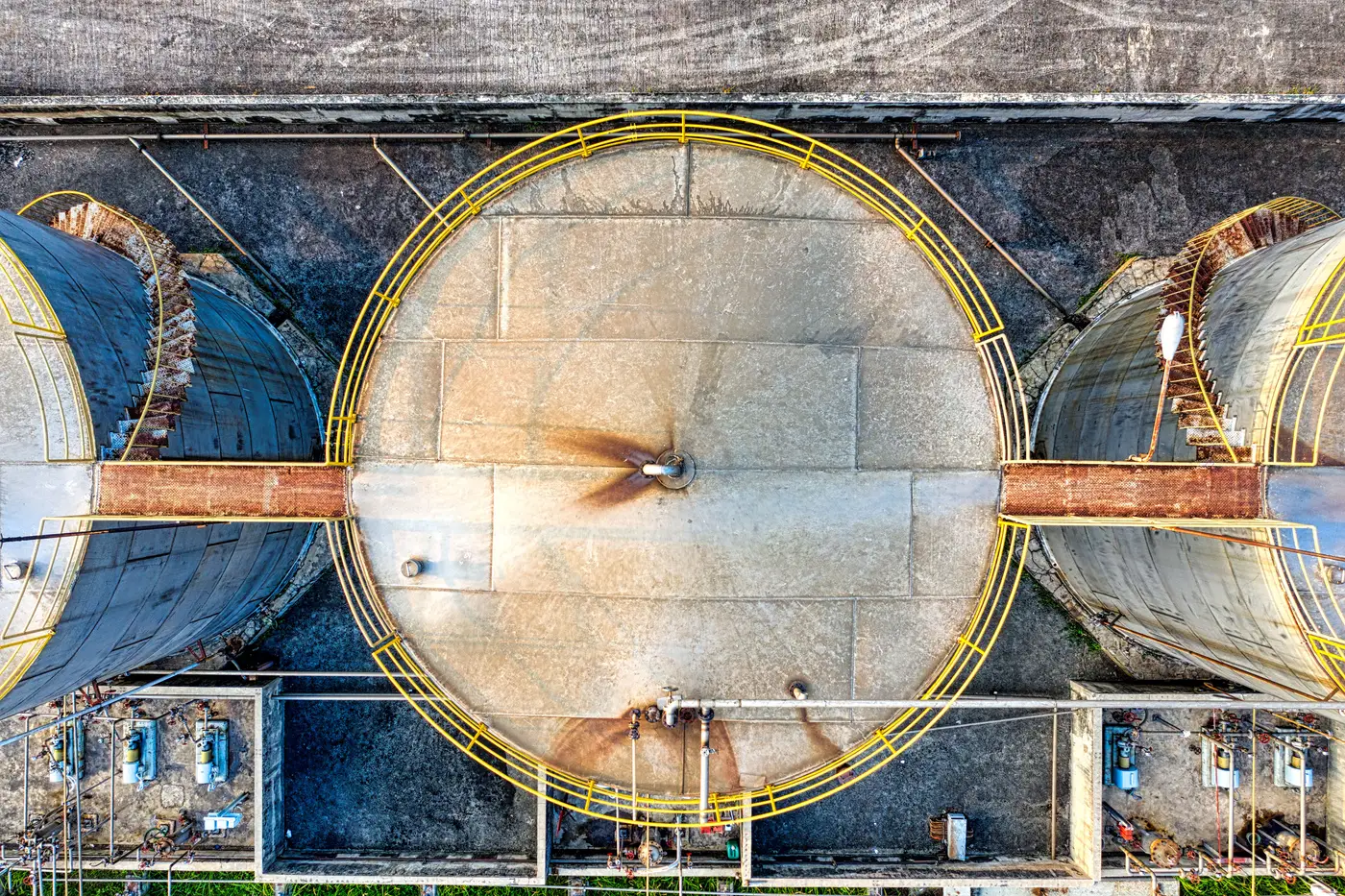
Traders rarely budget time to think about drainage hardware when they're trying to figure out how full a tank farm is. But if you've ever pulled a shadow-based fill estimate that jumped a few points for no obvious reason, the roof drain is one of the first things worth checking before you blame the methodology.
What a roof drain actually does
An external floating roof sits directly on the product, rising and falling with level. It isn't flat. Most decks carry a slight slope toward one or more low points so rainwater runs off instead of sitting on the steel. That runoff has to go somewhere, and it can't just spill over the rim into the tank, so operators route it through a drain that crosses the floating roof and discharges through the shell, usually near the bottom.
Two common designs show up across most fields of tanks. A flexible or articulated pipe drain uses hinged sections that telescope as the roof rises and falls. A siphon drain uses a hose that coils and uncoils with roof movement, running through the product itself to an outlet on the shell wall. Both are mechanical, both sit outdoors through every storm the site gets, and both clog or fail more often than operators would like, usually from debris, ice, or a sagging hose section that can't keep up with roof travel.
When a drain is working, rain sheets off the deck within a day or two and the roof surface stays dry and uniform. When it isn't, water pools exactly where the slope directs it to pool, which is usually near the drain sump itself.
How pooled water confuses a shadow read
A shadow-based fill estimate works off the geometry at the rim: how far down the roof sits relative to the tank wall, read from the length and angle of the shadow the wall and roof edge cast. That method depends on the roof behaving like a flat, predictable disk. Standing water breaks that assumption in a few distinct ways.
First, pooled water on a deck reads dark in overhead imagery, often close in tone to true shadow, so a boundary that should mark the edge of the roof's own shadow can blur into the edge of the wet patch instead. That's a straightforward source of shadow read error: the algorithm, or an analyst eyeballing the frame, ends up measuring water extent instead of shadow extent.
Second, ponding has weight. A few inches of rainwater across a large deck is tons of added load sitting unevenly on a structure that's only meant to float on product, not carry standing water. Enough of it and the roof can tilt or settle unevenly rather than staying level, which changes the actual geometry at the rim, not just the apparent one in the image. At that point the tank has a real roof condition that also happens to throw off the estimate.
Third, water surfaces glare and reflect differently than dry steel decking depending on sun angle, which can wash out contrast right where the shadow line needs to be sharp.
Any one of these can nudge a single day's fill estimate in a direction that doesn't match what's actually in the tank. None of them are reasons to throw out shadow geometry as a method. They're reasons to treat a lone outlier day with some skepticism, especially right after a rain event in the region.
What this means for your daily storage read
A daily cadence catches this better than a single sharp algorithm ever could. A tank that jumps the morning after a storm and settles back to its prior trend within a few reads is showing you a pooled-water artifact, not a real draw or fill. A tank that stays shifted for a week is showing you something else: a genuine level change, or a roof sitting unevenly that needs a maintenance call.
Oil Tank Fill runs that comparison for you by checking the same tanks daily rather than handing over a single snapshot, which is what the tool is built to do across a defined storage area. If you're piecing together fill estimates from whatever imagery your team can get hold of and want a daily read on the same set of tanks instead, that's the offer worth looking at.