Why roof legs flatten the shadow read near empty
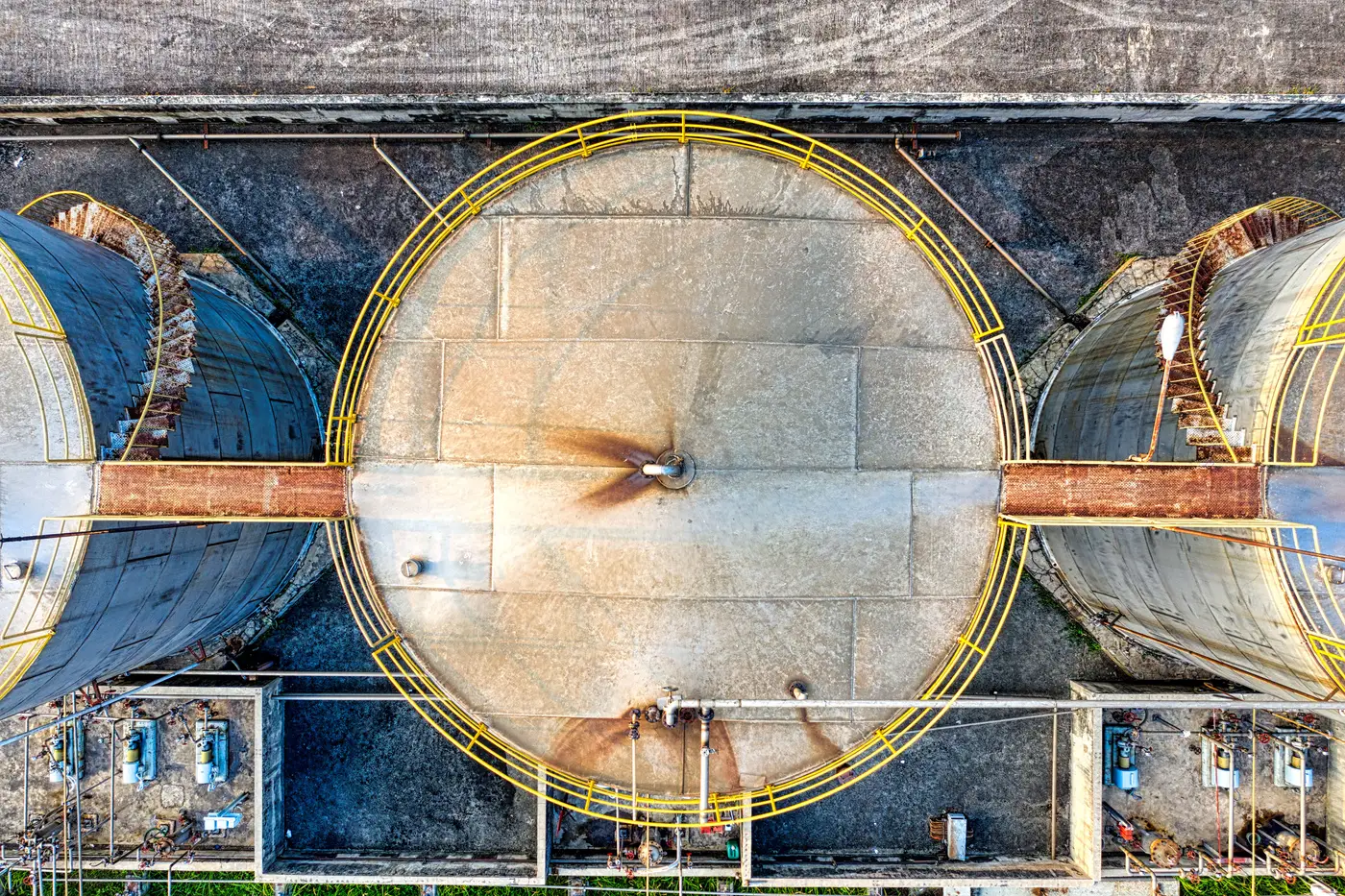
Anyone who's pulled a fill estimate from overhead imagery knows the shadow arc inside a floating roof tank is supposed to tell a clean story: longer shadow, lower roof, lower fill. That relationship holds for most of a tank's draw-down curve. It breaks down near the bottom. The cause is mechanical, and it has nothing to do with sun angle or image quality.
What the legs are actually for
A floating roof isn't welded to the tank. It sits on the product, usually a steel pontoon or double-deck structure, and rides up and down as crude is pumped in or drawn out. Underneath it are support legs, pipe columns bolted to the deck that can be pinned at two heights: a high-leg position (used during inspection or cleaning, when the roof needs clearance off the floor for workers to get underneath) and a low-leg position, which is the setting used during normal operation.
The low-leg setting exists for one reason: to stop the roof from grounding out on the tank floor and damaging the deck, the seals, or the drain system when the tank runs low. Operators set that clearance, typically a few feet, and once the roof touches down on the legs, it doesn't go any lower no matter how much more product gets drawn off.
Why the shadow geometry stops tracking fill
Here's the part that matters for a daily read. Shadow length inside the rim is a function of how far the roof has dropped below the top of the tank wall, times sun angle. As long as the roof is floating free on the liquid, that drop tracks the liquid level almost one-to-one, and the shadow lengthens in step with draw-down.
Once the roof settles onto its legs, the shadow stops tracking liquid level. The roof now rests at a fixed height off the floor, the low-leg height, whether there's three feet of product left in the tank or the tank is down to bottoms and sludge. The shadow geometry at that point reflects only the resting height of the legs. A tank reading, say, 8% from the shadow on Tuesday and 8% again on Friday might actually have moved several points in true fill, because the roof simply can't sink any further to show it.
That plateau is a hard mechanical floor on what the shadow can communicate, set by the legs themselves rather than by gauge error or imagery quality. Every floating-roof tank has one, and the low-leg clearance varies by tank design and operator practice, so it isn't a single universal cutoff across a tank farm.
What this means for reading a near-empty tank
The practical upshot: once a tank's shadow signature flattens out and stops lengthening day over day despite apparent throughput, that's usually the tell that the roof has touched down, not that fill has stabilized. Treat readings in that zone as "confirmed low, near bottom of working volume" rather than as a precise percentage. The same caution applies at the high end for different reasons, since the roof rim can bump the upper gauge pole, but the low-leg plateau is the one that shows up most often in balance-season draw-downs, when traders are watching PADD-level stocks tighten and every terminal's true bottom matters for basis calls.
It's also worth knowing which tanks in a given tank farm are older, lower-clearance designs versus newer builds with taller leg settings, since that changes where the plateau kicks in. That detail rarely shows up in any public filing, but a few months of daily shadow history on the same tank will show you where its particular floor sits.
This is exactly the kind of read-the-tank-before-the-report problem the daily per-tank fill estimates on Oil Tank Fill are built around, flagging each tank's shadow pattern against its own history so a flattened-out low read doesn't get mistaken for a stable one. If you're tracking a storage hub where bottoms matter to your position, it's worth seeing what a daily pass over your tanks looks like.